







































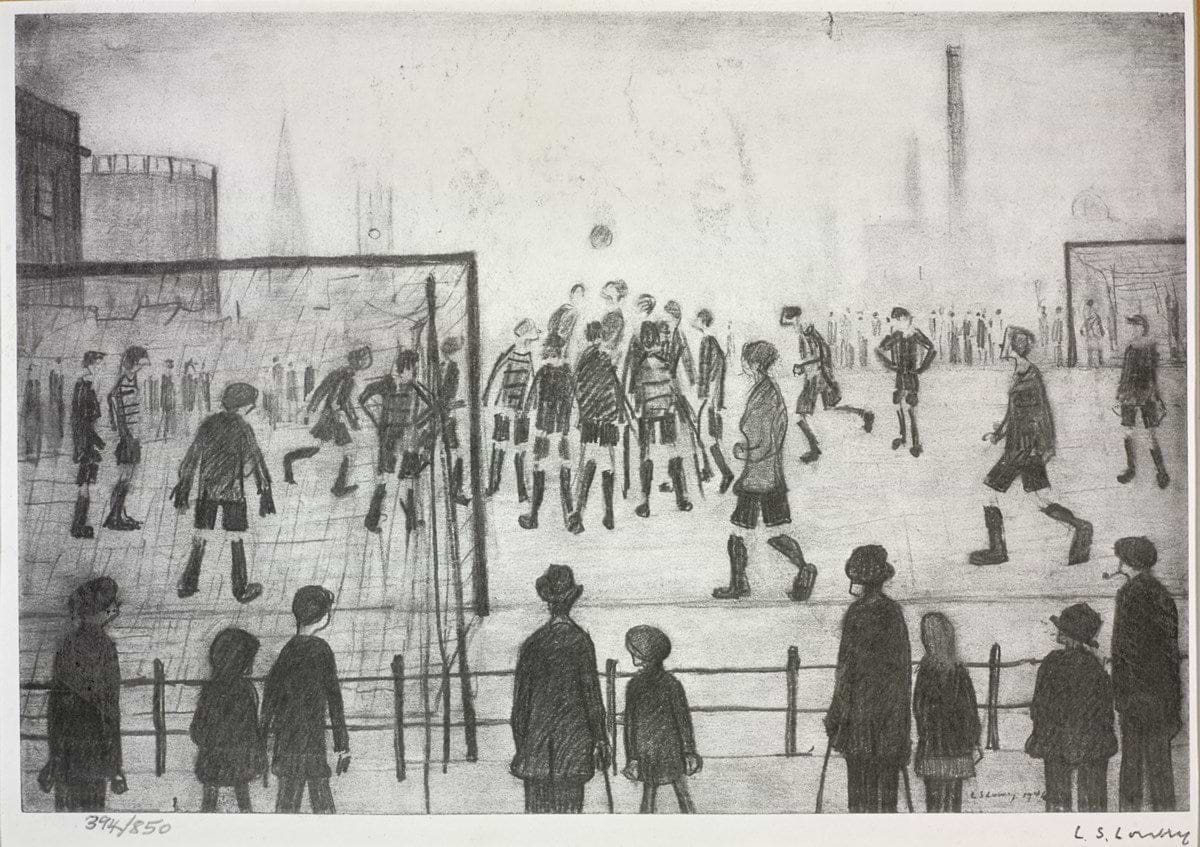


The Football Match 394/850
POA
Laurence Stephen Lowry, R.A. (1887-1976)
The Football Match, 1973
Offset lithograph on wove paper, after the original pencil drawing from 1946 of the same title (Collection: Private Collection)
Signed ‘L.S. Lo... Read More


Product Variations
The Football Match 394/850
POA
Laurence Stephen Lowry, R.A. (1887-1976)
The Football Match, 1973
Offset lithograph on wove paper, after the original pencil drawing from 1946 of the same title (Collection: Private Collection)
Signed ‘L.S. Lowry’ lower right and numbered from the edition of 850 lower left in pencil
Published by Harold Riley (with blindstamp lower left)
Size: 9 x 14 in. (22.3 x 35.5 cm.)
(Please enquire for availability)
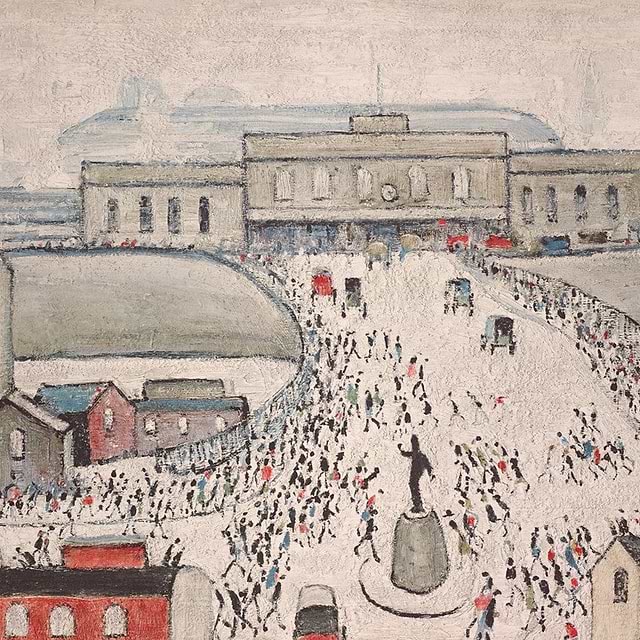
Unlike Lowry's best-known sporting picture (the magisterial Going to the Match housed in the Professional Footballer’s Association Collection) which depicts a specific location, Burnden Park, the former home of Bolton Wanderers, The Football Match is rather a celebration of the place that football held in the heart of the ordinary working man at a time when the teams of the North-west dominated English football with teams like Manchester United, Bolton, and Blackpool winning cups and titles year after year.
The prospect of such events being opportunities to see people in groups whose mood was almost tangible, be that in victory or defeat, clearly intrigued Lowry, and it is perhaps notable that Going to the Match, often lauded as one of the greatest football paintings, does not actually feature pitch, players, or ball. Indeed Andras Kalman, Lowry's friend and dealer and staunch Chelsea supporter remembered that if he wanted to tempt Lowry out from home, the offer of taking him to a match usually worked. In contrast, in The Football Match the game itself is central to the composition. Using just the merest deft touches, Lowry fills the pitch with players whose varied states of animation contrast well with the densely packed crowds along the touchline. Ostensibly unified, we know that these crowds will be divided at least two ways, and Lowry often used crowds as a vehicle for expressing the innate loneliness of individuals within the group.
The present work was published in 1973 by the celebrated Salford artist Harold Riley, Lowry’s friend and collaborator. Beginning in the 1960s, Lowry and Riley worked on a continuing project to document the city of Salford.
Although similarly rendered in the monochrome of the original pencil sketch, the present work is not to be confused with Lowry’s original lithographs which are not reproductions of original paintings or drawings, but rather made for the purpose, and published in smaller editions of 75.
UK Delivery
We offer free shipping on all online orders or collection from one of our galleries if this is more convenient for you.
Orders will usually be received in 7-14 days unless stated after purchase, we will contact you after you have placed your online order to confirm the details and delivery information.
Click here for more information on our delivery fees.
US Delivery
We offer free collection from our Westport gallery. For all online orders, it is important to note that additional charges for customs, duties, VAT, and other applicable fees may arise, and it remains your sole responsibility to settle these charges.
International Delivery
International delivery is available for an additional cost, please contact our client service team for more information.
Laurence Stephen Lowry, R.A. (1887-1976)
The Football Match, 1973
Offset lithograph on wove paper, after the original pencil drawing from 1946 of the same title (Collection: Private Collection)
Signed ‘L.S. Lowry’ lower right and numbered from the edition of 850 lower left in pencil
Published by Harold Riley (with blindstamp lower left)
Size: 9 x 14 in. (22.3 x 35.5 cm.)
(Please enquire for availability)
Unlike Lowry's best-known sporting picture (the magisterial Going to the Match housed in the Professional Footballer’s Association Collection) which depicts a specific location, Burnden Park, the former home of Bolton Wanderers, The Football Match is rather a celebration of the place that football held in the heart of the ordinary working man at a time when the teams of the North-west dominated English football with teams like Manchester United, Bolton, and Blackpool winning cups and titles year after year.
The prospect of such events being opportunities to see people in groups whose mood was almost tangible, be that in victory or defeat, clearly intrigued Lowry, and it is perhaps notable that Going to the Match, often lauded as one of the greatest football paintings, does not actually feature pitch, players, or ball. Indeed Andras Kalman, Lowry's friend and dealer and staunch Chelsea supporter remembered that if he wanted to tempt Lowry out from home, the offer of taking him to a match usually worked. In contrast, in The Football Match the game itself is central to the composition. Using just the merest deft touches, Lowry fills the pitch with players whose varied states of animation contrast well with the densely packed crowds along the touchline. Ostensibly unified, we know that these crowds will be divided at least two ways, and Lowry often used crowds as a vehicle for expressing the innate loneliness of individuals within the group.
The present work was published in 1973 by the celebrated Salford artist Harold Riley, Lowry’s friend and collaborator. Beginning in the 1960s, Lowry and Riley worked on a continuing project to document the city of Salford.
Although similarly rendered in the monochrome of the original pencil sketch, the present work is not to be confused with Lowry’s original lithographs which are not reproductions of original paintings or drawings, but rather made for the purpose, and published in smaller editions of 75.


Upon placing an order, we will promptly follow up with an email confirmation of the delivery timeline and address any additional queries you may have about your purchase, payment, or delivery. During this conversation, we will also finalize the details of your preferred delivery method.
Should you need assistance with the installation of fixings or your artwork, our galleries can provide a roster of reliable installers who can lend their expertise. Kindly inform our team before the delivery if such assistance is necessary.
Please note that this service incurs a charge. If your artwork is not yet ready to be hung, we will ensure it remains wrapped and ready for you or your chosen installer to hang at a more convenient time.
The majority of our limited edition artworks and select original pieces are accompanied by a certificate of authenticity. If a certificate is available for the artwork you have ordered, it will be included with your shipment.
Yes, we ship artwork to over 180 countries. Our reliable courier partners, primarily DHL, are entrusted with shipping your artwork worldwide. Occasionally, we may also utilize services from TNT or other similar providers.
For specific details regarding delivery costs, kindly refer to our dedicated delivery page. It is important to note that additional charges for customs, duties, VAT, and other applicable fees may arise, and it remains your sole responsibility to settle these charges.
Once you have made a purchase of your desired artwork, you have the option to either have it conveniently delivered to your home or arrange for collection at a gallery of your preference (excluding our ship-based galleries).
We aim to deliver your order within 7 - 14 days unless stated after purchase.
Prior to delivery, all artworks undergo a meticulous quality check process, which typically takes up to two weeks to complete. After your order is placed, our client services team will contact you with an estimated delivery date.
If you opt for delivery to a gallery of your choosing, an art consultant will reach out to notify you once the artwork has arrived. They will coordinate with you to arrange a convenient time for collection that suits your schedule.
To ensure a secure transit, every artwork is handled with utmost care. We take precautionary measures by using foam edges to protect each side of the artwork, followed by shrink-wrapping for added safety during transportation.
Clarendon Fine Art provides a personalized white glove service that grants you the opportunity to view your preferred artwork in the comfort of your own home. To arrange an appointment with an art consultant, kindly get in touch with a gallery of your preference.

You may also like
Recently viewed
- Choosing a selection results in a full page refresh.