





























The Family 182/850
POA
Laurence Stephen Lowry, R.A. (1887-1976)
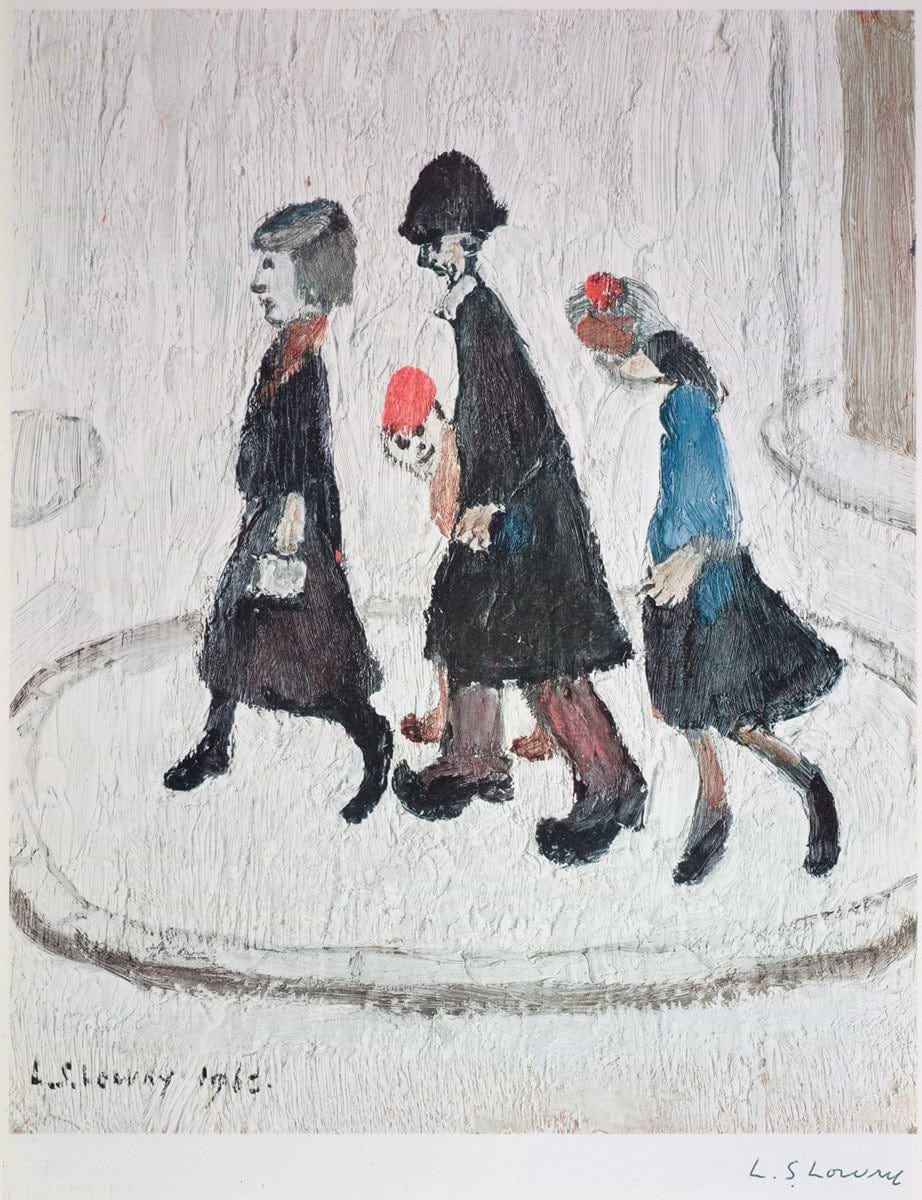
The Family, c.1972
Offset lithograph on wove paper, after the original oil painting from 1962 of the same title (Collection: Private Collection)
Signed ‘L.S. Lowry’ low... Read More


Product Variations
The Family 182/850
POA
Laurence Stephen Lowry, R.A. (1887-1976)
The Family, c.1972
Offset lithograph on wove paper, after the original oil painting from 1962 of the same title (Collection: Private Collection)
Signed ‘L.S. Lowry’ lower right in pencil
Stamped by the Fine Art Trade Guild and numbered from the edition of 850
Published by the Adam Collection Ltd.
Size: 10½ x 8½ in. (26.5 x 21.5 cm)
(Please enquire for availability)
Lowry is synonymous with images of the working class of the Industrial North, but he was not of those streets by birth. Instead, his family were of the ‘respectable’ Victorian lower-middle class for whom the threat of declining gentility was a real fear at the beginning of the century. Yet as the family’s fortunes altered, forcing them to move in 1909 to the then down-at-heel Manchester district of Pendlebury, the young Lowry found himself immersed in the lives of real working-class families. Shortly after the move to Pendlebury Lowry joined the Pall Mall Property company as a rent collector and clerk in (he would work there until his retirement, a fact which did not become widely known until after his death) and whilst walking his rounds he gained an intimate knowledge of the people and families he encountered and remained fascinated by their plight all his life.
In the present work, we see a smartly dressed family group – a father, mother and two children – going about their daily business. Although many of Lowry’s artworks depict groups of figures together, the sense of togetherness is not what it appears. Lowry once remarked of the people he observed: “All those people in my pictures, they are all alone. They have got all their private sorrows, their own absorption. But they can't contact one another. We are all of us alone - cut off. All my people are lonely. Crowds are the most lonely thing of all. Everyone is a stranger to everyone else. You have only got to look at them to see that.” This notion creates another dynamic to Lowry’s works and makes the viewer question what they originally perceived of these figures.
Lowry's interest in the figure is evident throughout his career but it was not until the late 1940s and 50s that he began to abandon his signature crowd scenes in favour of small groups of people and families, rendered with a more highly developed sense of individual identity. Indeed, during this time Lowry's figures become of such central importance that he begins to place them not against an urban backdrop, but simply against a white void so that the subject of the painting becomes the figures alone, or, crucially, the nebulous atmosphere inhabiting the spaces between them.
UK Delivery
We offer free shipping on all online orders or collection from one of our galleries if this is more convenient for you.
Orders will usually be received in 7-14 days unless stated after purchase, we will contact you after you have placed your online order to confirm the details and delivery information.
Click here for more information on our delivery fees.
US Delivery
We offer free collection from our Westport gallery. For all online orders, it is important to note that additional charges for customs, duties, VAT, and other applicable fees may arise, and it remains your sole responsibility to settle these charges.
International Delivery
International delivery is available for an additional cost, please contact our client service team for more information.
Laurence Stephen Lowry, R.A. (1887-1976)
The Family, c.1972
Offset lithograph on wove paper, after the original oil painting from 1962 of the same title (Collection: Private Collection)
Signed ‘L.S. Lowry’ lower right in pencil
Stamped by the Fine Art Trade Guild and numbered from the edition of 850
Published by the Adam Collection Ltd.
Size: 10½ x 8½ in. (26.5 x 21.5 cm)
(Please enquire for availability)
Lowry is synonymous with images of the working class of the Industrial North, but he was not of those streets by birth. Instead, his family were of the ‘respectable’ Victorian lower-middle class for whom the threat of declining gentility was a real fear at the beginning of the century. Yet as the family’s fortunes altered, forcing them to move in 1909 to the then down-at-heel Manchester district of Pendlebury, the young Lowry found himself immersed in the lives of real working-class families. Shortly after the move to Pendlebury Lowry joined the Pall Mall Property company as a rent collector and clerk in (he would work there until his retirement, a fact which did not become widely known until after his death) and whilst walking his rounds he gained an intimate knowledge of the people and families he encountered and remained fascinated by their plight all his life.
In the present work, we see a smartly dressed family group – a father, mother and two children – going about their daily business. Although many of Lowry’s artworks depict groups of figures together, the sense of togetherness is not what it appears. Lowry once remarked of the people he observed: “All those people in my pictures, they are all alone. They have got all their private sorrows, their own absorption. But they can't contact one another. We are all of us alone - cut off. All my people are lonely. Crowds are the most lonely thing of all. Everyone is a stranger to everyone else. You have only got to look at them to see that.” This notion creates another dynamic to Lowry’s works and makes the viewer question what they originally perceived of these figures.
Lowry's interest in the figure is evident throughout his career but it was not until the late 1940s and 50s that he began to abandon his signature crowd scenes in favour of small groups of people and families, rendered with a more highly developed sense of individual identity. Indeed, during this time Lowry's figures become of such central importance that he begins to place them not against an urban backdrop, but simply against a white void so that the subject of the painting becomes the figures alone, or, crucially, the nebulous atmosphere inhabiting the spaces between them.


Upon placing an order, we will promptly follow up with an email confirmation of the delivery timeline and address any additional queries you may have about your purchase, payment, or delivery. During this conversation, we will also finalize the details of your preferred delivery method.
Should you need assistance with the installation of fixings or your artwork, our galleries can provide a roster of reliable installers who can lend their expertise. Kindly inform our team before the delivery if such assistance is necessary.
Please note that this service incurs a charge. If your artwork is not yet ready to be hung, we will ensure it remains wrapped and ready for you or your chosen installer to hang at a more convenient time.
The majority of our limited edition artworks and select original pieces are accompanied by a certificate of authenticity. If a certificate is available for the artwork you have ordered, it will be included with your shipment.
Yes, we ship artwork to over 180 countries. Our reliable courier partners, primarily DHL, are entrusted with shipping your artwork worldwide. Occasionally, we may also utilize services from TNT or other similar providers.
For specific details regarding delivery costs, kindly refer to our dedicated delivery page. It is important to note that additional charges for customs, duties, VAT, and other applicable fees may arise, and it remains your sole responsibility to settle these charges.
Once you have made a purchase of your desired artwork, you have the option to either have it conveniently delivered to your home or arrange for collection at a gallery of your preference (excluding our ship-based galleries).
We aim to deliver your order within 7 - 14 days unless stated after purchase.
Prior to delivery, all artworks undergo a meticulous quality check process, which typically takes up to two weeks to complete. After your order is placed, our client services team will contact you with an estimated delivery date.
If you opt for delivery to a gallery of your choosing, an art consultant will reach out to notify you once the artwork has arrived. They will coordinate with you to arrange a convenient time for collection that suits your schedule.
To ensure a secure transit, every artwork is handled with utmost care. We take precautionary measures by using foam edges to protect each side of the artwork, followed by shrink-wrapping for added safety during transportation.
Clarendon Fine Art provides a personalized white glove service that grants you the opportunity to view your preferred artwork in the comfort of your own home. To arrange an appointment with an art consultant, kindly get in touch with a gallery of your preference.

You may also like
Recently viewed
- Choosing a selection results in a full page refresh.